
Best Smart Speakers of 2026
The right speaker for Alexa, Google Home, Apple Home — and every budget.
Find the best smart speaker for your home. We compare Amazon Echo, Google Nest Audio, Apple HomePod, and Sonos across every price point and ecosystem.
Smart speakers have moved well beyond playing music on command. Today's models can control your entire smart home, answer questions, set reminders, make calls, and act as the central hub for your automation routines. Choosing the right one mostly comes down to which ecosystem you're already in — or plan to build around.
We've analyzed the leading options across price points and ecosystems so you can find the speaker that fits your home, your budget, and the devices you already own.
The best smart speakers at a glance
| Speaker | Best For | Ecosystem | Price Range |
|---|---|---|---|
| Amazon Echo (4th Gen) | Best overall Alexa speaker | Alexa | $$ |
| Echo Dot (5th Gen) | Best budget pick | Alexa | $ |
| Echo Studio | Best Alexa audio quality | Alexa | $$$ |
| Google Nest Audio | Best for Google Home | Google Home | $$ |
| Google Nest Mini (2nd Gen) | Best small Google speaker | Google Home | $ |
| Apple HomePod (2nd Gen) | Best for Apple Home | Apple Home | $$$$ |
| Apple HomePod mini | Best compact Apple speaker | Apple Home | $$ |
| Sonos Era 100 | Best multi-room audio | Alexa / multi | $$$ |
1. Amazon Echo (4th Gen) — Best overall Alexa smart speaker
The standard Echo remains the go-to recommendation for most people entering the Alexa ecosystem. Its spherical design sounds better than it looks, delivering a noticeably fuller sound than earlier flat-topped models — enough to fill a medium-sized room comfortably.
What makes this model stand out beyond sound is the built-in Zigbee hub. That means you can connect Zigbee devices like Philips Hue bulbs and certain sensors directly to the Echo, without a separate hub. For someone building a basic smart home, this alone can save real money on hardware.
Key specs
- Voice assistant: Alexa
- Connectivity: Wi-Fi (2.4 GHz / 5 GHz), Bluetooth
- Built-in hub: Zigbee (also supports Matter via software)
- Audio: 3" woofer + dual front-firing tweeters
- Smart home control: Alexa-compatible devices, routines, skills
Compatibility
Works with Alexa-compatible devices across all major brands. Supports Matter as a controller. The built-in Zigbee hub adds direct support for Zigbee devices without a third-party hub.
Pros
- Solid all-around audio at a reasonable price
- Built-in Zigbee hub — uncommon at this price point
- Deep Alexa smart home integration
- Supports Matter
- Frequently on sale
Cons
- Tied to the Alexa ecosystem
- Audio doesn't match dedicated Bluetooth speakers at the same price
- Privacy considerations with always-on microphone
Best for: Anyone starting an Alexa smart home who wants a capable speaker and a basic Zigbee hub in one device.
2. Amazon Echo Dot (5th Gen) — Best budget smart speaker
The Echo Dot is the entry point for Alexa and the best-selling smart speaker on the market. The 5th generation model brought a meaningful audio upgrade — noticeably more bass than its predecessor — plus a built-in temperature sensor that can trigger automations based on room conditions.
Don't expect room-filling sound. The Dot is designed for smaller spaces: a bedside table, a kitchen counter, a home office. At its price, it's hard to beat as a starting point, and buying several to cover different rooms is still cheaper than a single full-size speaker.
Key specs
- Voice assistant: Alexa
- Connectivity: Wi-Fi (2.4 GHz / 5 GHz), Bluetooth
- Built-in hub: None
- Sensors: Temperature sensor
- Audio: 1.73" front-firing speaker
Compatibility
Full Alexa compatibility. Works as a Matter controller. No built-in Zigbee hub — for hub functionality, step up to the standard Echo or Echo Hub.
Pros
- Lowest cost entry into Alexa
- Improved bass vs previous gen
- Temperature sensor adds automation potential
- Small footprint
Cons
- No built-in hub
- Audio limited for larger rooms
Best for: Bedrooms, kitchens, and anyone who wants a low-cost Alexa device for voice control without high audio expectations.
3. Amazon Echo Studio — Best Alexa speaker for audio quality
If you want the best sound Amazon makes in a smart speaker, the Echo Studio is it. Five built-in speakers — a 5.25" woofer, a midrange driver, and three tweeters — plus automatic room adaptation make a noticeable difference compared to the standard Echo. It supports Dolby Atmos and Sony 360 Reality Audio for compatible streaming content.
Like the standard Echo, the Studio includes a built-in Zigbee hub. It also functions as a Matter controller. For audiophiles who want to stay inside the Alexa ecosystem without buying a separate audio system, this is the only serious option Amazon offers.
Key specs
- Voice assistant: Alexa
- Connectivity: Wi-Fi, Bluetooth, 3.5mm / optical audio input
- Built-in hub: Zigbee + Matter controller
- Audio: 5-driver array, Dolby Atmos, 360 Reality Audio
Pros
- Best audio quality of any Echo
- Dolby Atmos and 360 Reality Audio support
- Built-in Zigbee hub
- Line-in for external audio sources
Cons
- Premium price
- Ecosystem-locked to Alexa
- Large footprint
Best for: Alexa users who want strong audio performance and don't want to manage a separate smart speaker and hub setup.
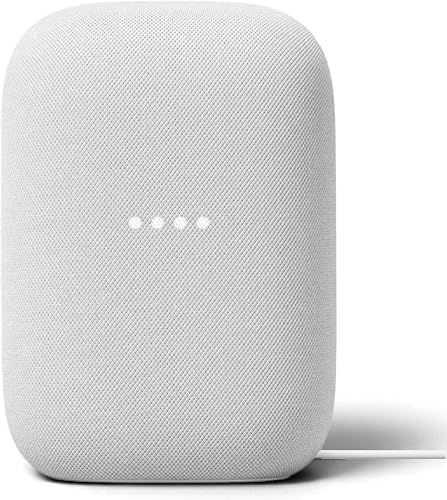
4. Google Nest Audio — Best smart speaker for Google Home
The Google Nest Audio delivers noticeably better sound than its predecessor (the original Google Home) and remains Google's primary mid-range smart speaker. Its audio is clear and balanced — particularly good for podcasts, spoken content, and music — and Google Assistant's contextual understanding still outperforms Alexa on complex or conversational queries.
It doesn't include a built-in smart home hub, but it acts as a Thread border router and supports Matter, which covers a growing range of devices. For Google Home users, this is the cleanest choice at the $100 price point.
Key specs
- Voice assistant: Google Assistant
- Connectivity: Wi-Fi (2.4 GHz / 5 GHz), Bluetooth
- Thread border router: Yes
- Matter controller: Yes
- Audio: 75mm woofer + 19mm tweeter
Compatibility
Native Google Home ecosystem. Acts as a Thread border router, enabling direct Thread device connections. Supports Matter as a controller. Compatible with Chromecast audio groups for multi-room setup.
Pros
- Strong audio for the price
- Google Assistant — better at natural language queries
- Thread border router built in
- Matter support
Cons
- No Zigbee hub
- Ecosystem-locked to Google Home
- No display
Best for: Google Home users who want a capable speaker and a Thread border router in one device.
5. Google Nest Mini (2nd Gen) — Best budget Google speaker
The Nest Mini is the Google equivalent of the Echo Dot — affordable, compact, and a solid entry point into Google Home. Sound quality is adequate for smaller rooms and voice commands; don't expect it to replace a Bluetooth speaker for music listening. It can be wall-mounted, which is a convenient option for hallways or rooms without a good surface placement.
Key specs
- Voice assistant: Google Assistant
- Connectivity: Wi-Fi (2.4 GHz / 5 GHz), Bluetooth
- Audio: 40mm driver
- Wall mount: Built-in slot
Pros
- Affordable entry into Google Home
- Wall-mount compatible
- Small footprint
- Google Assistant
Cons
- Weak bass, limited volume
- No Thread border router (unlike Nest Audio)
- No hub functionality
Best for: Rooms where you mainly want voice control and music isn't a priority — hallways, bathrooms, offices.
6. Apple HomePod (2nd Gen) — Best smart speaker for Apple Home
The 2nd generation HomePod is the best smart speaker Apple has made, and it shows. The audio — driven by a high-excursion woofer, a five-tweeter array, and Apple's spatial audio processing — is genuinely impressive for a standalone speaker at this size. It automatically adapts to its position in the room using sensors.
Beyond audio, the HomePod is a full Apple Home hub, a Thread border router, and a Matter controller. For Apple Home users, it's the most capable hub-plus-speaker combination available. Temperature and humidity sensors are built in, enabling automation without additional hardware.
The main limitation is ecosystem exclusivity — it's designed to work seamlessly with iPhone and Apple devices, and the experience outside that ecosystem is significantly reduced.
Key specs
- Voice assistant: Siri
- Connectivity: Wi-Fi 4 (802.11n), Bluetooth 5.0, Ultra Wideband
- Apple Home hub: Yes
- Thread border router: Yes
- Matter controller: Yes
- Built-in sensors: Temperature, humidity
- Audio: 4" high-excursion woofer, 5-tweeter array, spatial audio
Compatibility
Requires an Apple ID. Full Apple Home integration including remote access and automations. Supports Matter and Thread. Handoff with iPhone for seamless audio transfer. Works with Siri only — Google Assistant and Alexa are not supported.
Pros
- Excellent audio quality
- Full Apple Home hub functionality
- Thread border router + Matter controller
- Built-in temperature and humidity sensors
- Spatial audio and room sensing
Cons
- Requires iPhone for full setup and features
- Premium price
- Siri less capable than Alexa or Google Assistant for third-party integrations
- No line-in
Best for: Apple Home users who want a premium speaker that also serves as a hub, Thread border router, and environmental sensor.
7. Apple HomePod mini — Best compact Apple smart speaker
The HomePod mini is the more accessible entry into Apple's speaker ecosystem. At around $99, it delivers sound quality that punches above its size — partly thanks to Apple's computational audio processing — and retains the key smart home features: Apple Home hub, Thread border router, and Matter controller. That's a lot of functionality in a small package.
Like the full HomePod, it requires an Apple ID and an iPhone for initial setup. Intercom between multiple HomePod minis (or with other Apple devices) is genuinely useful in larger homes.
Key specs
- Voice assistant: Siri
- Connectivity: Wi-Fi (802.11n), Bluetooth 5.0, Ultra Wideband
- Apple Home hub: Yes
- Thread border router: Yes
- Matter controller: Yes
- Audio: Full-range driver + passive radiators
Pros
- Full Apple Home hub + Thread border router at $99
- Compact design
- Intercom across Apple devices
- Good audio for the size
Cons
- Requires Apple ID / iPhone
- No temperature sensor (unlike full HomePod)
- Siri limitations vs Alexa / Google Assistant
Best for: Apple Home users who want hub functionality in a compact, affordable speaker.
8. Sonos Era 100 — Best for multi-room audio
Sonos doesn't build a dedicated smart home speaker in the same way Amazon, Google, or Apple do — but the Era 100 is the company's best compact option for people who prioritize audio quality and want multi-room flexibility. It supports Alexa and Sonos Voice Control, connects via Wi-Fi or Ethernet (with an adapter), and pairs with other Sonos speakers for synchronized playback across rooms.
The Era 100 replaced the Sonos One and added stereo sound (using two tweeters angled left and right), Bluetooth for direct playback, and a USB-C input for connecting audio sources. It also acts as a Matter controller and a Thread border router.
Sonos compatibility spans a wide range of streaming services and voice assistants, making it the least ecosystem-locked option on this list.
Key specs
- Voice assistant: Amazon Alexa, Sonos Voice Control
- Connectivity: Wi-Fi (2.4 GHz / 5 GHz), Bluetooth 5.0, USB-C line-in
- Thread border router: Yes
- Matter controller: Yes
- Audio: Angled tweeter array + woofer, stereo sound
- Multi-room: Full Sonos multi-room system
Compatibility
Works with Alexa and Sonos Voice Control. Integrates into Sonos multi-room audio system. Supports Matter and Thread. Compatible with major streaming services including Spotify, Apple Music, Tidal, and Amazon Music.
Pros
- Best audio quality on this list
- Genuine stereo sound from a single unit
- Flexible ecosystem — not locked to one voice assistant
- Thread border router + Matter support
- USB-C audio input
Cons
- Premium price
- No Google Assistant support
- No Apple Home hub
- Smart home integration less deep than Echo or HomePod
Best for: Audio-focused users who want multi-room sound and don't want to be locked into a single ecosystem.
How to choose the right smart speaker
Stick with your ecosystem
The single most important factor is which smart home ecosystem you use or plan to build. Echo speakers work best in Alexa homes, Nest speakers in Google Home, and HomePods in Apple Home. Mixing ecosystems is possible with Matter, but native integration is always smoother.
Consider whether you need a hub
If you plan to use Zigbee devices (like many Philips Hue, IKEA, or Aqara products), a speaker with a built-in Zigbee hub saves you from buying one separately. The Echo (4th Gen) and Echo Studio both include one. HomePods and Nest Audio include Thread border routers instead, which is useful for Thread-based Matter devices.
Audio quality expectations
Budget speakers (Echo Dot, Nest Mini) are adequate for voice commands and background music. For real listening, step up to the Echo Studio, Nest Audio, HomePod, or Sonos Era 100. The audio gap is significant.
Room size
Compact speakers work well in bedrooms, kitchens, and offices. For living rooms or open-plan spaces, choose a full-size model or consider a pair of smaller speakers in stereo mode if the ecosystem supports it.
Smart speaker compatibility quick reference
| Speaker | Alexa | Google Assistant | Siri | Zigbee Hub | Thread BR | Matter |
|---|---|---|---|---|---|---|
| Echo (4th Gen) | ✅ | ❌ | ❌ | ✅ | ❌ | ✅ |
| Echo Dot (5th Gen) | ✅ | ❌ | ❌ | ❌ | ❌ | ✅ |
| Echo Studio | ✅ | ❌ | ❌ | ✅ | ❌ | ✅ |
| Google Nest Audio | ❌ | ✅ | ❌ | ❌ | ✅ | ✅ |
| Google Nest Mini 2 | ❌ | ✅ | ❌ | ❌ | ❌ | ❌ |
| Apple HomePod 2nd Gen | ❌ | ❌ | ✅ | ❌ | ✅ | ✅ |
| Apple HomePod mini | ❌ | ❌ | ✅ | ❌ | ✅ | ✅ |
| Sonos Era 100 | ✅ | ❌ | ❌ | ❌ | ✅ | ✅ |
Frequently asked questions
Can I use an Amazon Echo with Google Home?
Not directly. Echo speakers run Alexa and integrate with the Alexa ecosystem. They don't support Google Assistant or Google Home natively. However, both ecosystems are adding Matter support, which enables some cross-ecosystem device control — but the voice assistant experience remains separate.
Do smart speakers work without a subscription?
Basic smart home control (lights, locks, routines) works without a subscription on all listed speakers. Music streaming typically requires subscriptions to services like Spotify, Amazon Music, or Apple Music, though free tiers are available on some platforms. No speaker on this list requires a subscription for core smart home functionality.
What's the difference between a smart speaker and a smart display?
Smart displays (like the Echo Show or Google Nest Hub) add a touchscreen to the smart speaker experience. They can show visual information — camera feeds, recipes, calendar, video calls — in addition to audio responses. Smart speakers are audio-only.
Can I use a smart speaker as a Bluetooth speaker?
Most smart speakers support Bluetooth pairing to receive audio from a phone without using Wi-Fi or a voice assistant. The Sonos Era 100 and Echo models all support this. It's a useful fallback but isn't the primary use case these speakers are designed for.
What smart speaker is best if I have no smart home devices yet?
The Amazon Echo (4th Gen) is a practical starting point. It includes a Zigbee hub, supports Matter, and the Alexa ecosystem has the broadest device compatibility of any smart home platform. If you're an iPhone user committed to the Apple ecosystem, the HomePod mini is a strong alternative.
Where to Buy

Affiliate links — we may earn a commission at no extra cost to you.


